 CS2
CS2
There is no shortage of superstar power in modern Counter-Strike. Vitality have ZywOo, Falcons have their own high-impact core, and several other Tier 1 teams can lean on a player capable of taking over a map.
But Team Spirit's relationship with donk is different.
A new visualization from Counter-Strike analyst Sam "LuzRaposa" Carder puts numbers behind something that has been increasingly obvious whenever Spirit take the server: donk's individual duel impact is dramatically higher than the average level of the players around him.
And the gap is not small.
On the chart, donk is effectively in a category of his own.
Donk Is Almost Off the Chart
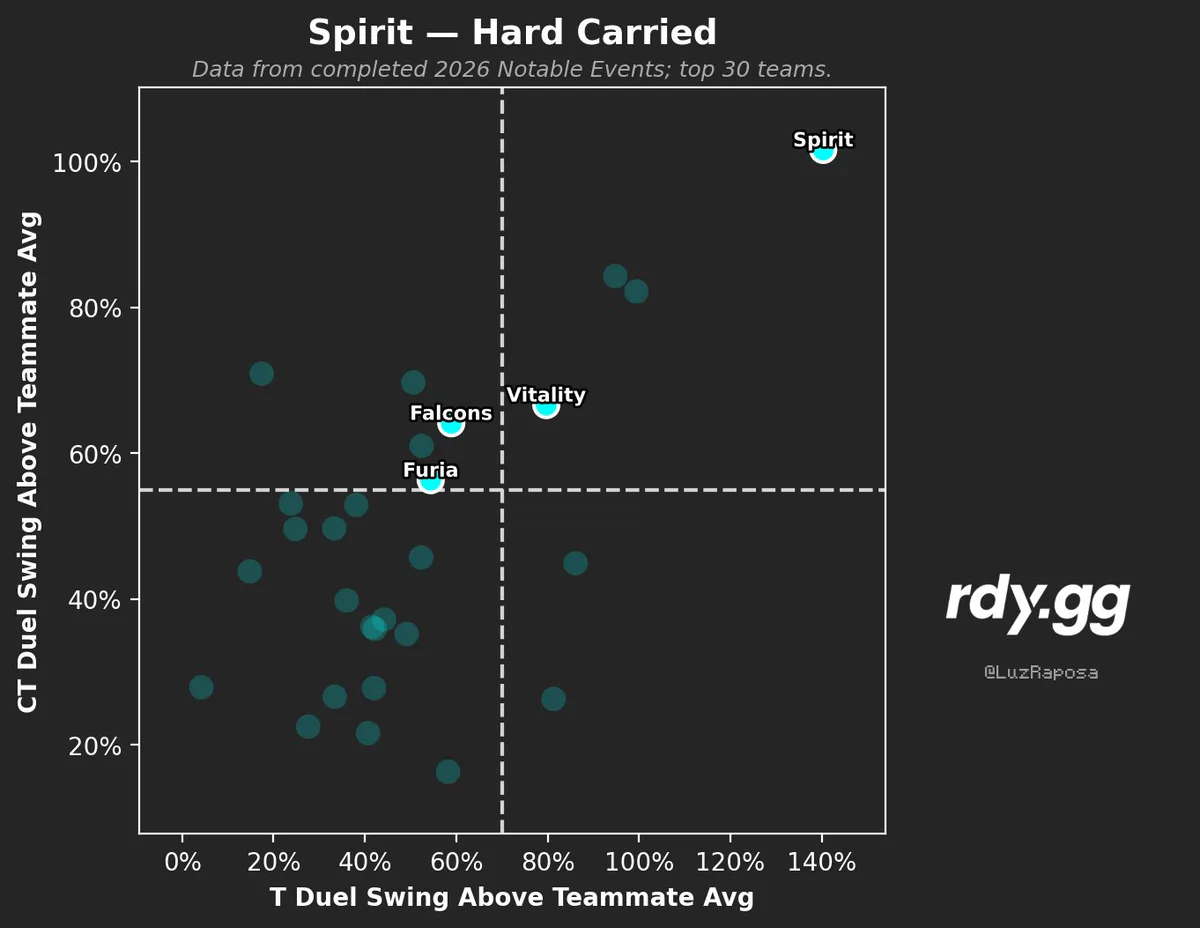
The visualization covers the top 30 teams from completed notable events in 2026 and compares players according to their Duel Swing above their team's average on both sides of the map.
Donk lands at roughly 141% above Spirit's team average on the T side and just over 100% above it on the CT side.
The next highlighted stars are nowhere close.
Vitality's representative sits at approximately 80% T-side and 66% CT-side, while Falcons are around 59% and 64%, respectively. FURIA's numbers are roughly 54% on T and 57% on CT.
That makes Spirit's dot on the graph almost impossible to miss — or, more accurately, almost impossible to compare with anything else.
The distance between donk and the rest of the field is the story.
What Does Duel Swing Actually Measure?
The metric is important because this isn't simply another rating leaderboard.
Duel Swing attempts to measure how much better or worse a player performs in gunfights than the situation would normally predict. The model takes factors such as a player's position, health, armor, weapons, vision and distance into account when estimating the expected outcome of a duel.
In other words, winning a completely even AK-vs-AK duel is not treated in the same way as killing a fully equipped opponent while fighting from an unfavorable position.
That makes the metric particularly interesting for evaluating raw firepower.
And this is where donk becomes such an extreme outlier.
He isn't simply taking a large number of fights. He is consistently producing results that exceed what the circumstances of those fights would suggest.
That combination — volume plus efficiency — is what separates him from the rest of the graph.
Spirit Have a Different Problem From Other Superstar Teams
The obvious question is whether this is actually a weakness.
It can be.
Teams such as Vitality can build a much more evenly distributed fragging structure around their superstar. If ZywOo has a quieter map, Vitality still have other players capable of taking over key portions of the game.
The same principle applies to other teams with multiple high-level riflers.
Spirit, by comparison, appear to have a much larger gap between their superstar and the team's baseline.
That does not mean donk's teammates are bad. It means the relative amount of responsibility placed on him is unusually high.
This distinction matters.
A team can have a player putting up superstar numbers without being dependent on him. Spirit's numbers suggest that they are much closer to the other end of that spectrum.
The T-Side Gap Is Particularly Striking
The most eye-catching number on the graphic is donk's approximately 141% T-side Duel Swing above Spirit's team average.
The reason that matters is that the T side tends to demand proactive individual play. Opening duels, creating space and converting difficult engagements are all critical to building a successful attack.
That is exactly the environment in which donk can become devastating.
When Spirit need someone to create the first advantage, donk is often the player capable of making something happen out of nothing.
And the data suggests that his impact in those situations isn't merely high by Tier 1 standards — it is exceptionally high compared with his own teammates.
That is a much more interesting statistic than simply saying that donk has a high rating.
Why This Makes Spirit So Dangerous
There is an obvious upside to having a player this far above the team average.
Spirit's ceiling is enormous.
If donk is winning the difficult fights, finding opening kills and consistently turning low-percentage situations into advantages, Spirit can make rounds look completely unfair.
Opponents can execute a sound game plan and still lose the round because donk has won a duel that he was statistically not expected to win.
That is one of the defining qualities of truly elite players.
But it creates a problem for Spirit as well.
If an opponent manages to restrict donk's opportunities, the rest of the roster has to provide significantly more of the firepower. And that is where the comparison with more balanced superstar teams becomes relevant.
Vitality Show the Other Side of the Equation
Look at Vitality on the same graphic.
Their leading player is still sitting comfortably above the team's average, at roughly 80% T-side and 66% CT-side. Those are elite numbers.
But the separation is much smaller.
That's arguably a healthier structure for a team trying to win a long tournament.
The superstar can still decide a map, but the opponent has more players to worry about. If the star is contained, someone else can step into the spotlight.
That is the luxury Spirit don't necessarily have.
And it is why the phrase "one-man carry" is more than just a meme in this particular discussion.
"It Isn't Even Close"
LuzRaposa's conclusion is blunt: “donk is the hardest one-man carry in the entirety of Tier 1, and it isn't even close.”
The visualization certainly supports the argument.
Importantly, this does not prove that donk is automatically a better overall player than every other superstar represented in the comparison. Duel Swing is one metric, and Counter-Strike is far too complex to reduce a player's value to a single number.
Calling, utility, trading, positioning, clutching and team structure all matter.
But the graph isn't trying to answer the question of who is the "best player."
It is answering a different question:
How far above his own team's average level is a superstar performing in high-value gunfights?
On that question, the answer is overwhelmingly clear.
It's donk.
The Real Question for Spirit
This is what makes the data particularly relevant for Spirit going forward.
They don't necessarily need donk to stop carrying them. That would be impossible to ask of a player whose biggest strength is precisely his ability to create extraordinary individual impact.
What Spirit need is for the rest of the roster to reduce the amount of carrying that is necessary.
If another player can consistently win the opening duel, close out a round or punish an opponent for focusing too heavily on donk, Spirit become much harder to prepare for.
The ideal version of the team isn't one where donk stops being the superstar.
It's one where opponents can no longer afford to build their entire defensive plan around him.
Donk's Advantage Could Also Become Spirit's Biggest Weapon
There is an interesting paradox at the heart of the numbers.
The same statistic that highlights Spirit's dependence on donk also explains why the team can be so dangerous.
A player this far above his team's baseline gives Spirit something that most teams simply cannot replicate: a reliable source of disproportionate individual impact.
The challenge is turning that individual advantage into a team advantage.
If Spirit can get more consistent production from the rest of the roster while donk continues operating anywhere near his current level, the gap between them and the other elite teams could become much smaller in the only metric that ultimately matters — winning playoff series.
For now, though, the graph paints a remarkable picture.
Vitality have a superstar. Falcons have a superstar. Several Tier 1 teams have superstars.
Spirit have donk — and according to this data, the gap between their star and the rest of the team is on another level entirely.